


Flux and It’s Role in the Galvanizing Process
Flux and It’s Role in the Galvanizing Process
 In the hot-dip galvanizing industry, one of the most critical stages in the pre-treatment tanks before the material is dipped into the zinc kettle is the flux bath. The flux bath represents the final cleaning and preparation step before galvanization. This process ensures that the steel is completely clean before being immersed in the zinc kettle. Insufficient cleaning can lead to various issues in the galvanizing process, preventing the coating from adhering properly.
Flux Chemical Structure and Components
Flux chemicals are generally divided into two categories based on their component contents: double-salt flux and triple-salt flux. This distinction is based on the ratios of zinc chloride (ZnCl₂) and ammonium chloride (NH₄Cl) they contain. Double-salt flux consists of 56% zinc chloride and 44% ammonium chloride, while triple-salt flux contains 44% zinc chloride and 56% ammonium chloride.Functions and Reactions of Flux
The components in flux play a critical role in the quality and efficiency of the galvanizing process. Zinc chloride (ZnCl₂) helps prevent the steel from rusting before it is dipped into the zinc kettle, thus preventing oxidation. By creating a temporary anti-corrosive barrier, zinc chloride ensures that the steel does not oxidize between the flux bath and the zinc kettle.
Ammonium chloride (NH₄Cl), on the other hand, plays an active role in the zinc kettle.
(ZnCl₂) helps prevent the steel from rusting before it is dipped into the zinc kettle, thus preventing oxidation. By creating a temporary anti-corrosive barrier, zinc chloride ensures that the steel does not oxidize between the flux bath and the zinc kettle.
Ammonium chloride (NH₄Cl), on the other hand, plays an active role in the zinc kettle. Upon transition into the zinc kettle, NH₄Cl participates in three key reactions:
- Removal of Iron Oxide: NH₄Cl removes iron oxide (FeO) from the steel surface.
- 2NH₄Cl + FeO → H₂O + 2 NH₃ + FeCl₂
- Reaction with Zinc Oxide: NH₄Cl reacts with zinc oxide (ZnO), reducing some of it to zinc chloride, thereby recovering usable zinc in the process.
- 2NH₄Cl + ZnO → H₂O + NH₃ + ZnCl₂:NH₃
- Sublimation and Improvement of Zinc Fluidity: At 338°C, NH₄Cl vaporizes and sublimates on the surface of zinc. This increases the fluidity of zinc, allowing it to flow more easily and spread evenly over the surface. This process reduces zinc consumption and improves coating quality.
Advantages of Flux
The use of flux in the galvanizing process offers several significant benefits, including: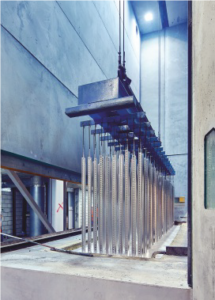
- Prevents Oxidation: Flux prevents the steel from oxidizing between the cleaning stage and the galvanization process.
- Removes Rust: It eliminates any thin rust layer remaining on the material after acid cleaning.
- Reduces Zinc Consumption: Flux helps to reduce zinc waste during the galvanization process.
- Reduces Zinc Dross Formation: Flux minimizes the formation of zinc dross.
- Reduces Dross Formation: Flux reduces the amount of dross produced during the galvanization process.
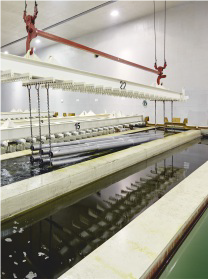
- Improves Coating Thickness: The use of flux can help achieve more consistent coating thickness.
- Promotes Uniform Coating: Flux contributes to better coating quality and surface smoothness.
- Increases Process Speed: The flux bath accelerates the galvanizing process, improving production efficiency.
- Prevents Coating Defects: Flux reduces the occurrence of defects and imperfections in the final coating.
- Improves Quality: Overall product quality is enhanced, and the galvanizing process is improved.
Effectiveness of Flux and Concentration Settings
The effectiveness of flux is maximized when used under the right conditions. This requires using the correct type of flux, at the right time, with the proper concentration and component ratio. The ratios of NH₄Cl and ZnCl₂ in the flux significantly impact process efficiency, and it is essential to adjust these ratios accurately. These adjustments are typically made through monthly sampling and external laboratory analysis.
Flux concentration is usually monitored through simple density measurements (e.g., using a hydrometer). This provides a good estimate of the total salt concentration in the flux. For double-salt flux, the suitable density range is between 1.19 and 1.21 SG (Baume 23-26), while for triple-salt flux, it is between 1.15 and 1.19 SG (Baume 15-23). These density values correspond to a salt concentration range of 400-550 g/liter.
type of flux, at the right time, with the proper concentration and component ratio. The ratios of NH₄Cl and ZnCl₂ in the flux significantly impact process efficiency, and it is essential to adjust these ratios accurately. These adjustments are typically made through monthly sampling and external laboratory analysis.
Flux concentration is usually monitored through simple density measurements (e.g., using a hydrometer). This provides a good estimate of the total salt concentration in the flux. For double-salt flux, the suitable density range is between 1.19 and 1.21 SG (Baume 23-26), while for triple-salt flux, it is between 1.15 and 1.19 SG (Baume 15-23). These density values correspond to a salt concentration range of 400-550 g/liter.
Flux Consumption and Application
Flux consumption occurs in the following ways: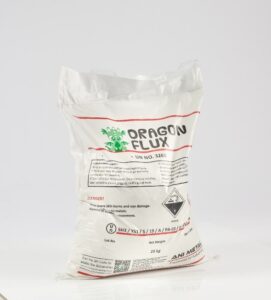
- Reaction with the steel surface: Flux chemically reacts with the steel during the cleaning process.
- Carried over by the material: Flux is carried along with the material as it moves through the process.
Conclusion and Recommendations
Proper use of flux is crucial for maximizing the efficiency and quality of the galvanizing process. The composition and concentration of flux should be monitored and adjusted through appropriate testing. By making regular, small additions of flux, its concentration can be stabilized, resulting in improved quality, reduced costs, and faster production speeds. This ensures that high-quality, homogeneous, and defect-free coatings are achieved throughout the galvanizing process. For the most effective utilization of the benefits mentioned above, don’t forget to check out our best-selling, world-renowned flux, Dragon Flux.